Showing posts with label western sahara. Show all posts

Tuesday, March 10, 2015

Saharan lichens, fungi and the "Maltese mushroom"

Saharan lichens


I saw a few mushrooms as well, but these were pretty sparse. I never found the secotioid fungus below in a mature state, and I'm not sure of its identity.

Phellorinia sp.? 
immature Phellorinia sp?. near camp (Thanks Scott R. for suggesting Phellorinia)

One of the most interesting finds was a parasitic flower, Cynomorium coccineum. The inflorescences look very much like mushrooms from afar, and when I first saw a cluster by the side of the road I asked the Zbyzsek to stop the car. I wasn't the first to think so-- the common English name is the "Maltese mushroom." 
Cynomorium coccineum in a dry river valley. 
The plants have a global distribution and are valued as a food resource and panacea across many different culture groups. For a better look at their peculiar history, read this article.


The base of this flowering structure was attached to a pale thin taproot, which I followed to the succulent shrub (Atriplex sp.?) at right. Unfortunately, the taproot was somewhat brittle and broke during excavation. These plants don't photosynthesize, and instead harvest nutrients from the host shrub, a lifestyle known as holoparasitism. 

These were found in nearly all shrubby desert areas we visited.
The phylogeny of these plants is uncertain, largely because some of the genetic markers commonly used to analyze the the relationships between different taxa affiliate with conflicting lineages--one suggests Cynomorium is more closely related to the Saxifragales, while another suggests Sapinales. This may be because parasitic plants are so closely associated with their hosts they can undergo horizontal gene transfer (Barkman et al. 2007), though Cynomorium isn't known to currently associate with members of either lineage. Strange plants indeed.


Saturday, February 28, 2015

Detour to Morocco [Western Sahara]

Two days after I landed in London to start a stint working on the Lost & Found Fungi Project at the Royal Botanic Gardens (Kew), a disease ecologist friend I met in South Africa asked me if I was able to join a field trip to Morocco to catch rodents in the Sahara. So, of course, 24 hours later I was in Porto meeting the other members of the expedition while we packed the car for the drive from Portugal to Morocco. We had dinner in Porto, left at 2 am, had breakfast in Spain, took a ferry, and had lunch in Morocco. 

Basic daily routine: pack up camp, drive a few hours to a new trapping site, set up traps and a camp nearby, relax for a few hours until sunset, then drive slowly through the desert with headlamps stuck out the windows and nets at the ready to spot and chase nocturnal rodents on foot. 

We caught lesser Egyptian jerboas (Jaculus jaculus) by chasing them with nets in pairs or groups of three. This is probably the closest to hunting I'll ever come. 

Book of North African mammals in hand, Zbyzsek asks (sort of, there's a language barrier) local camel/goat-herding nomads about rodents of the area.

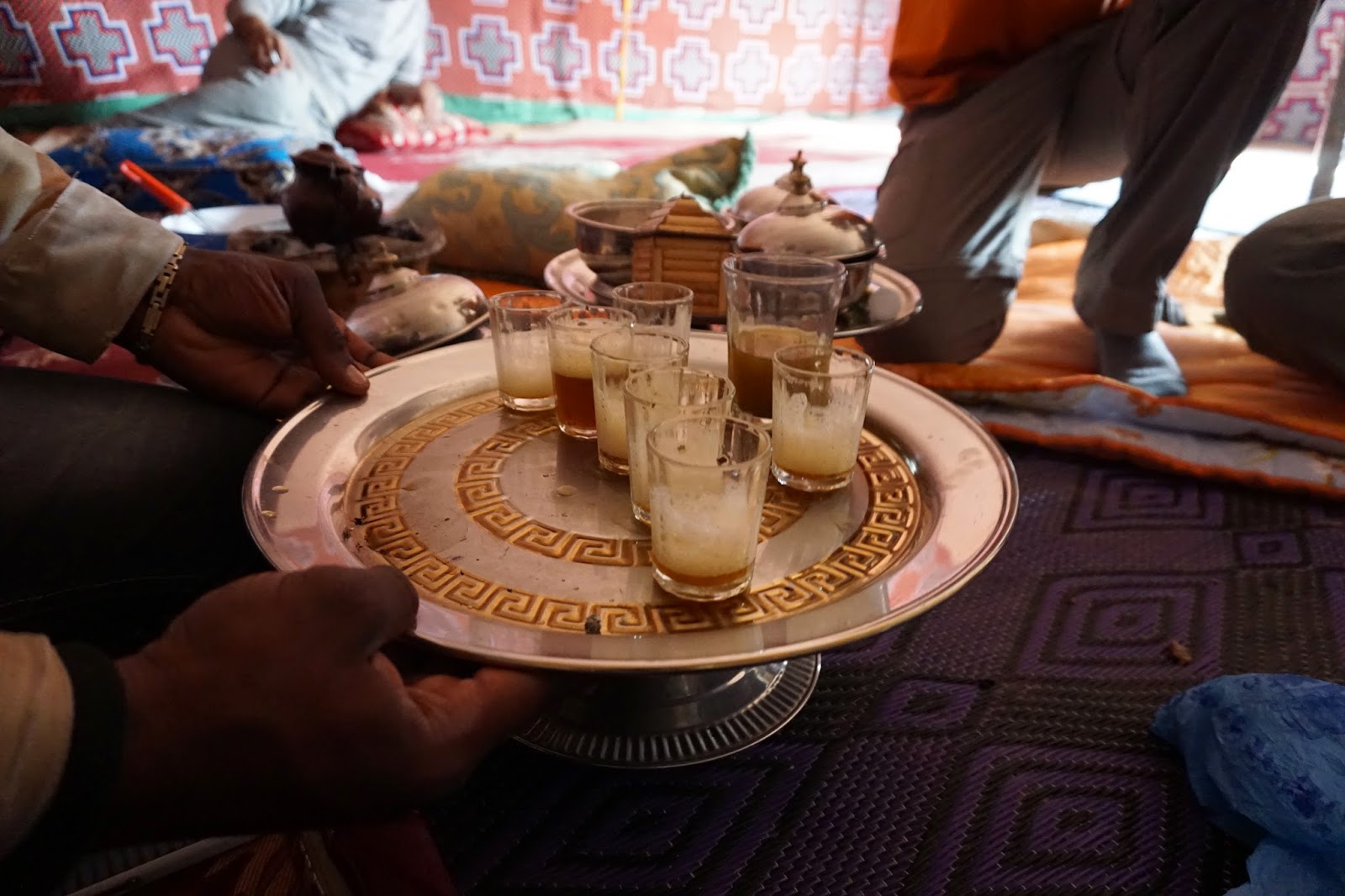
Sometimes this develops into an invitation for afternoon tea. The tea is very sweet green tea, and there is some ceremony to the pouring.
Herds of camels graze on the winter greenery.
Kris sets traps to catch gerbils and attempts to keep dust out of his eyes/ears/nose/mouth. A relentless wind that drove dust into everything started mid-trip, and I didn't take many pictures during these dust storms to spare my camera the damage.
Zbyszek and Filipa return from setting traps during the 4-day dust storm.


There were some very spectacular landscapes.


Sometimes the dunes would creep over the roads and we had to go offroad to avoid getting stuck in the sand.


Filipa and Kris hard at work in the office.
Thick layer of quartz geodes in an eroded cliff bordering a riverbed. Much of the cliff was composed of flint embedded in chalk.
Geode from above site


Fresh(ish) fox skull