Showing posts with label thomas j watson fellowship. Show all posts

Sunday, October 26, 2014

Jungle ads


Over a month ago, I was on a short trek in the jungle heading back to Juara beach on Tioman Island after spending the afternoon at a waterfall in the jungle. As I walked, I spotted a polypore that had been broken off a log and placed on top of it, perhaps by a passing group of hikers. Some of the shelf mushrooms that have very fine pale pore surfaces can be used to write messages. The most famous example of a fungus with this characteristic is Ganoderma applanatum, known as the Artist's Conk. I'm not sure what species this example is. 
Of note: many of these larger, very solid polypores can continue to release spores for seasons, so please resist the urge to break them off the substrate.

I scribbled a message on the underside, leaving this diminutive billboard with one of the smallest possible audiences--hikers with good eyes taking the difficult route to a particular waterfall off the less-trafficked beach of a small Malaysian island in the South China Sea.

Today I received an email from a vertebrate/invertebrate researcher with this picture attached. Not exactly guerrilla marketing, but probably about as close as I'm going to get. 

(Thanks for the email, Reuben.)


[Currently working on a more detailed post about contract mushroom farming in developing countries, sorry for the delay in posting]

Thursday, September 25, 2014

Fungus and conservation at Sakaerat biosphere reserve (Thailand)


[Hiking through a dry stream bed in Sakaerat during a collecting trip]

Fungi pose peculiar compounding problems in the context of conservation. These issues range from research/infrastructural problems like the unfinished and shifting foundation of taxonomy and lack of funding for biodiversity surveys and other non-commercializable research, to global problems like the rate of habitat loss and limited awareness of and interest in fungal diversity. 


[Throughout the post are images of fungi (and some insects) found at the Sakaerat Bioreserve in Thailand.]

[A harmless giant millipede climbs a large Chlorophyllum]

 The original fungal classification system was based on morphological features, but current DNA-based molecular research methods have caused enormous shifts in mycologists' understandings of what delimits a fungal species and how the taxonomic groups are related. Because most early studies of mycology were conducted in Europe, most species descriptions and identification resources unevenly emphasize European species, and molecular work has made it clear that in many cases applying the name of a similar-looking European species to a collection from another continent is misleading and inaccurate.


[Bright orange agarics- Cystoagaricus trisulphuratus, or Agaricus crocopeplus?]
 I've noticed in Thailand and Malaysia that what few macrofungal identification resources exist are incomplete and/or inaccurate. This highlights a critical problem in fungal conservation--if the fungi aren't identified correctly or have yet to be formally described, then establishing distribution and identifying which are threatened is virtually impossible. These problems only apply where there has been at least an attempt at surveying the fungal biodiversity, but because of lack of funding, interest, and mycologists, not enough surveying has been done. Some current surveys focus on using only molecular data/DNA sequencing, but the databases that the sequences are referenced against are incomplete/inaccurate and these surveys depend on resources that may not be available in developing countries (particularly in the case of "next generation"/high throughput sequencing). 


[Phillipsia domingensis - a very conspicuous and red disc fungus that was inaccurately given the name Sarcoscypha coccinea in multiple local ID books]

When so many fungi (including the microfungi unrepresented in this post) have not been documented or described, the simplest way to conserve fungi is to maintain undisturbed habitat and continue the efforts to document native fungi. Conservation is a dual act—ideally it includes practical efforts that directly affect the organisms of interest (habitat preservation, culture banking, inoculation of trees with endangered symbiotic species, etc) and it has to change land-use behaviors and educate local people, as human activity is generally accepted as the single largest threat to biodiversity.  
[An Austroboletus parasitized by a species of Hypomyces]


 Sakaerat is a UNESCO biosphere reserve consisting of a core area of uninhabited primary forest, with a surrounding buffer zone of restored forests containing a few villages. Briefly, the goal of biosphere reserves is to connect people to their environments with an emphasis on sustainability and conservation. This approach is pretty interesting-- it aims to both conserve habitat and maintain local peoples' stake in the area.  


[Auricularia spp. - appropriately called tree ear. Species of this genus are commonly eaten in Chinese cuisine]


While reserves by definition are protected from the major land-use changes and tree harvesting that threaten many forests, Sakaerat faces particular challenges because of Thai peoples' traditional use of forest products. In Thailand, people tend to see forests as "free grocery stores," but as human population has increased and forest cover has decreased, forest product use has largely become unsustainable. Resource overuse heavily disturbs habitats, and many sought-after organisms (notably slow-growing trees and slow-reproducing animals) aren't able to maintain reproductive populations. To encourage sustainable use, Sakaerat Environmental Research Station hosts researchers working on projects in the forest, and has very frequent 2-3 day science/nature camps for Thai highschool students that emphasize the value of biodiversity and aim to change the way the next generation of Thais see the forest.
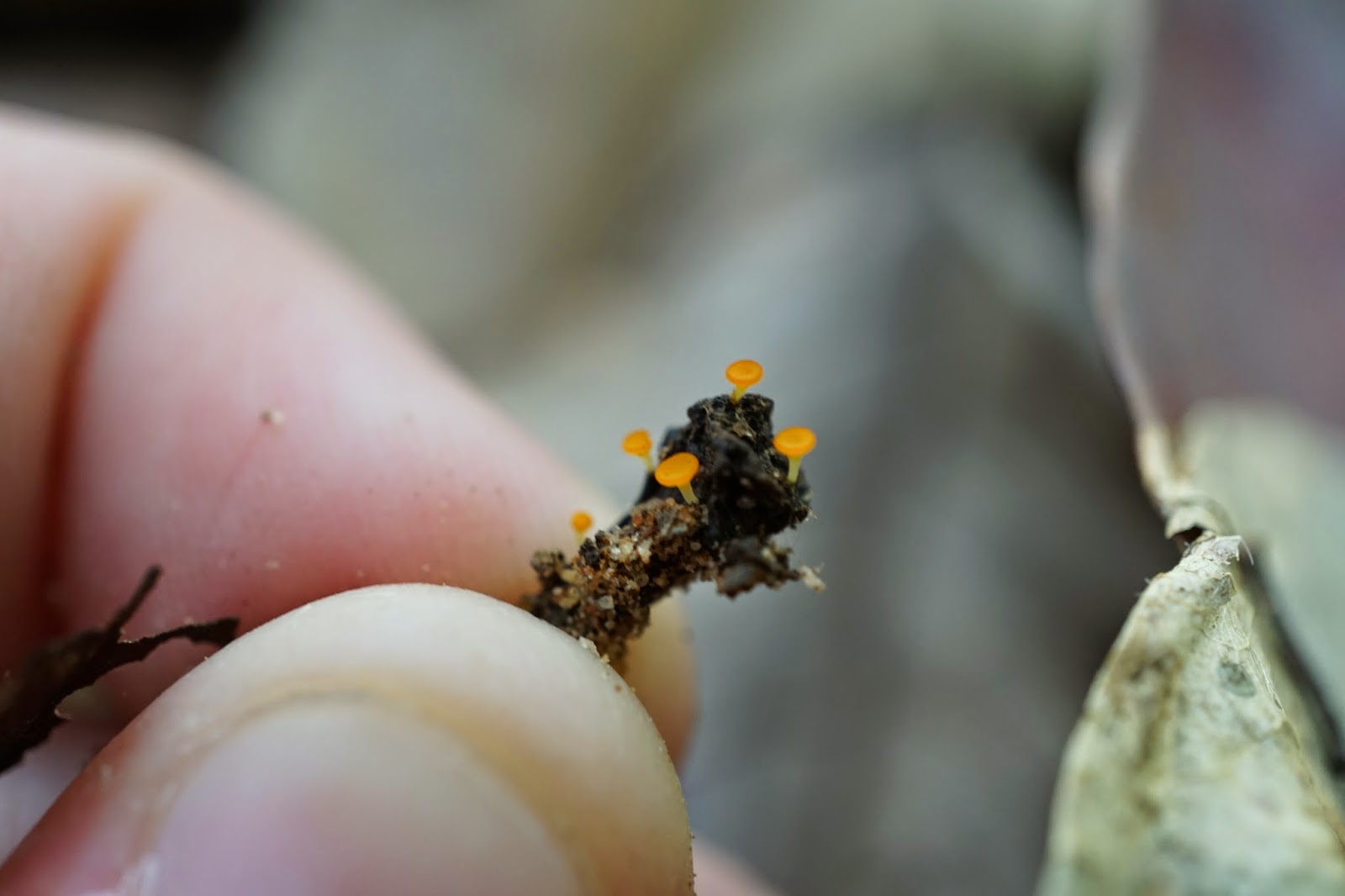
 
[Tiny orange cup fungus]
Sakaerat management has largely been able to reduce poaching by relocating villages located in the core region of the forest and maintaining a force of rangers, but mushroom poaching is the notable exception. A week after a heavy rain, there are easily a dozen mushroom vendors with stalls within walking distance of the entrance to the park. There have been conflicting studies on whether or not mushroom harvesting damages fungal populations (as the mushroom is a fruiting body connected to a larger mycelial organism), but undoubtedly heavy harvesting leads to habitat disturbance.

[A shopping bag of mixed wild mushrooms bought from one of many roadside stands -- boletes, Russulas, Amanitas, and more]


The problem is that it is impossible to stop mushroom poaching unless the poachers have access to an alternative source of income. There simply aren't enough rangers to prevent poaching by force, and eliminating a major source of local villagers' income would be a public-relations/local politics disaster contrary to the idea of maintaining positive human-environment interaction and including local people in conservation. 


[This batch looks like mostly Amanita]


Though this observation is based on a single day's trip to the mushroom vendors and may not be representative, the mushroom poachers appeared to be village women in their forties/fifties who specialized in mushrooms. Frustratingly, my grasp of Thai is extremely limited and I couldn't ask them questions about their work, their concerns about the business, or the reliability of mushrooms as a source of income. 


[There was great diversity and abundance of tiny leaf-litter-decaying fungi]


Sakaerat started a project to educate local people on methods to grow mushrooms and provided spawn/materials in an attempt to turn the poachers into cultivators, but this initiative didn't become self-sustaining before funding fell through. In theory, mushroom cultivation could provide a more stable source of income while reducing mushroom poaching, but until the project is restarted (and there are plans to do so) it is impossible to guess how successful it would be--would consumers discriminate between wild and cultivated species, effectively making two separate markets? it would be a big lifestyle change, are the locals willing to fully adopt cultivation? 


[Tiny, unusual pileal shape, Marasmius sp.?]


Though mushroom poaching continues for the foreseeable future, the management of Sakaerat recognizes that conservation isn't a solution but a never-ending effort, continued with ongoing research support, constant education efforts, cooperation with local people, and creative solutions to unsustainable resource use.


[A tree-like form of one of the Xylariales]
This very brief post on fungal conservation problems and efforts was partly sourced from the 2008 publication Fungal Conservation: Issues and Solutions (Moore, Nauta, Evans, Rotheroe) and discussions with mycologists and Mister Taksin, the Sakaerat forest manager. 


Particular thanks to Taksin for welcoming me (unscheduled) to the research station and for managing the biosphere reserve in an exceptional way, and to Alexander for letting me actively join his fungal diversity work in Sakaerat.


[Sakaerat hosts great insect diversity as well]


[If you look above my leg, a bee with beautiful blue striping is about to land and drink my sweat.]


[Insects provide hosts for parasitic fungi, including Ophiocordyceps nutans]


[O. nutans fruiting body poking out of soil. The insect host of the fungus was slightly buried.]


[O. nutans victims are typically stinkbugs (wiki)]


Sunday, August 10, 2014

Highlights from the Mushroom Research Centre workshop on Northern Thailand diversity (July 28- August 2)


Most days of the workshop consisted of a collection foray to a local forest in the morning, and an evening in the lab. Many participants were collecting for a specific project, but I took the workshop as an opportunity to hike, work on my mushroom photography, learn how to morphologically identify more mushrooms to genus, and ask other participants about their work. More pictures are on my Flickr photostream (on the right bar of the blog).


Eske and Kadri in their natural habitat.


This Cookeina sp. was particularly large and impressive. This genus is often called "eyelash cup fungus" for obvious reasons.


Thailand has a high diversity and abundance of Ophiocordyceps s.l. species. These fungi parasitize various insects and arachnids and fruit spectacularly from their corpses. The one pictured is probably O. nutans.


Some sort of coralline fungus (Calocera ?) appearing through the leaf litter.


The exoskeleton of a cicada, shed on the underside of an old polypore fungus. When I found it, there was an ant crawling across the mold growing on the exoskeleton left on a fungus, which was also growing mold. Peculiar interactions.

Termitomyces sp. for sale at a roadside stand. This genus is distinctive-- the pointed cone on top is quite solid and often coated in dirt, evidence of how they have to push their way through the packed soil of a termite mound. This genus is named for its obligate symbiotic relationship with termites, which "farm" fungal mycelium. The mushroom fruits from the cultivated mass in an underground termite colony. They are widely eaten and command a relatively high price.


This bolete is being parasitised by another fungus.


This species typically fruits from pine cones.


A typical collection box containing small or fragile specimens. Larger collections are wrapped in tin foil and placed in a basket.


One of my favorite shots of very small fruiting bodies of some sort (Xylariaceae?) that had almost completely covered a large log.


Eske takes pictures with intensity for her taxonomic work on Lactifluus/Lactarius.
A beautiful Amanita. The cap was covered in fragile, powdery "warts" that crumbled at the lightest touch.
A very unusual bolete.


One day, these dogs followed us from start to finish.


The view from one of the day's hikes.


These were very small but striking.


A milk cap exuding "milk/latex" from a small cut.


A member of the genus Phallus.


The only picture of me from the field, with backpack, camera bag, collection box, and anti-mosquito jacket. Thanks Henri for taking it.
Beautiful fungus - Panellus sp.
"Bruising" response of a bolete
Taken by Alvin Tang-- group picture of most of us.


Bamboo forest.


Saturday, July 26, 2014

Maejo University -- Mushroom Cultivation Training + Sustainability Program


Maejo University is an agricultural university on the outskirts of Chiang Mai. The campus is large and contains many rather scenic agricultural installations but few people. 

We walk through one large building that seems completely empty except for cases of enormous insects mounted with pins. After hearing voices down a hallway, we knock on an office door and discover we are in the wrong building.
A man in the office redirects us to another nearby large white building, where a similar process repeats. I lose the specifics here, as all conversations have been in Thai.

Eventually we find a young man who is knowledgeable about the mushroom cultivation/education program, though I didn’t catch his actual position. At this point, all program specifics and questions are being translated and this kind of mediated conversation invites imprecise language and some inaccuracy, so some details may reflect that.

The mushroom cultivation area consists of a large covered platform with a pile of substrate, wood or coal-fired steam sterilization stations, and a series of concrete huts. The substrate in this case is rubber tree sawdust, lime to lower the pH, and likely some other nitrogen source. The University experimented with a few different types of substrate ranging from other types of sawdust, rice hulls, sugar cane bagasse, and straw, but settled on rubber tree sawdust because the mushrooms seemed to grow the best on it. All substrates are sourced from local agricultural waste— when a professor at Maejo later describes the program, he emphasizes the focus on sustainability and rural poverty reduction.


The program is rather clever, with a three-fold impact.  The first impact is the reuse of agricultural waste products, the second is the production of a nutritious and popular food resource, and the third is the creation of an accessible education resource so farmers can fully apply mushroom cultivation practices on their own. The University produces mushrooms and refines the process based on available materials, holds workshops that allow local rural farmers to grow their own mushrooms and purchase pure cultures from the University lab, and sells pre-made inoculated bags to local villagers who don't have the resources to have a full growing operation. These bags sell for 7 baht each, and can produce (in best conditions) 5 flushes of mushrooms, each worth 12 baht, giving the producer ~50 baht of profit ($1.60) per bag.

The young man leads us through their cultivation system, naturally starting with substrate and ending with growing sheds. Notably, this operation is geared towards primary decomposers and doesn't require the substrate composting like farms growing Agaricus species. This makes for a simpler process. 


Substrate and steam pasteurizing equipment. Substrate was mainly rubber tree sawdust.

Ash chute in the sterilizer -- a wood/coal fire heats water into steam which is funneled into industrial drums containing bags of substrate

Bags of sterilized substrate, ready to be inoculated


Pure culture of various strains. Pieces of the "parent" bottle are used to inoculate other bottles (containing agar or potato dextrose substrate) to maintain the same genetic strain. Pieces of the "parent" bottles are also used to inoculate bottles of millet seed which is then used to inoculate larger bags of growing substrate.

This strain exudes a dark liquid. Each strain/species' colony looks a bit different. I'm not sure which species this is, as bottles were grouped and labelled in Thai.

Millet seeds are inoculated by pure culture. The fully colonized seeds are then used to inoculate the bags of substrate. Colonized millet is also sold to farmers who make their own substrate bags. The quality and purity of a strain is a critical part of mushroom farming.

Closeup of myceliated millet.

Inoculated millet seeds visible at the top of a recently sterilized bag of substrate.


"Front" of mycelium as it grows throughout the substrate, top to bottom. It may take a week or more to get to this point. Probably a Pleurotus species.
A particularly beautiful growth pattern. Species uncertain.


Fully colonized bags, ready to be placed in a temp/humidity (semi)controlled room for fruiting.


A stack of bags in the fruiting room.

Fruiting. Because of inconsistencies between common names, scientific names, labeling, and translation, I'm refraining from naming most of the specimens pictured in this post. For example, these were labelled as "Grey oyster mushrooms, Pleurotus sajor-caju (Fr.)Singers", but according to the Wikipedia article referencing a Stamets book, cultivators commonly call warm-weather varieties of Pleurotus pulmonarius this name even though this species doesn't realllly exist as a separate entity and the actual P. sajor-caju was moved to the Lentinus genus... but there was also a Lentinus species in the same room though I don't think it was L. sajor-caju. Again, I'm going to refrain from labeling so I don't perpetuate any incorrect information.


Underside detail


The product.

Consequences of some form of bacterial contamination.

Another product.

Product in situ.

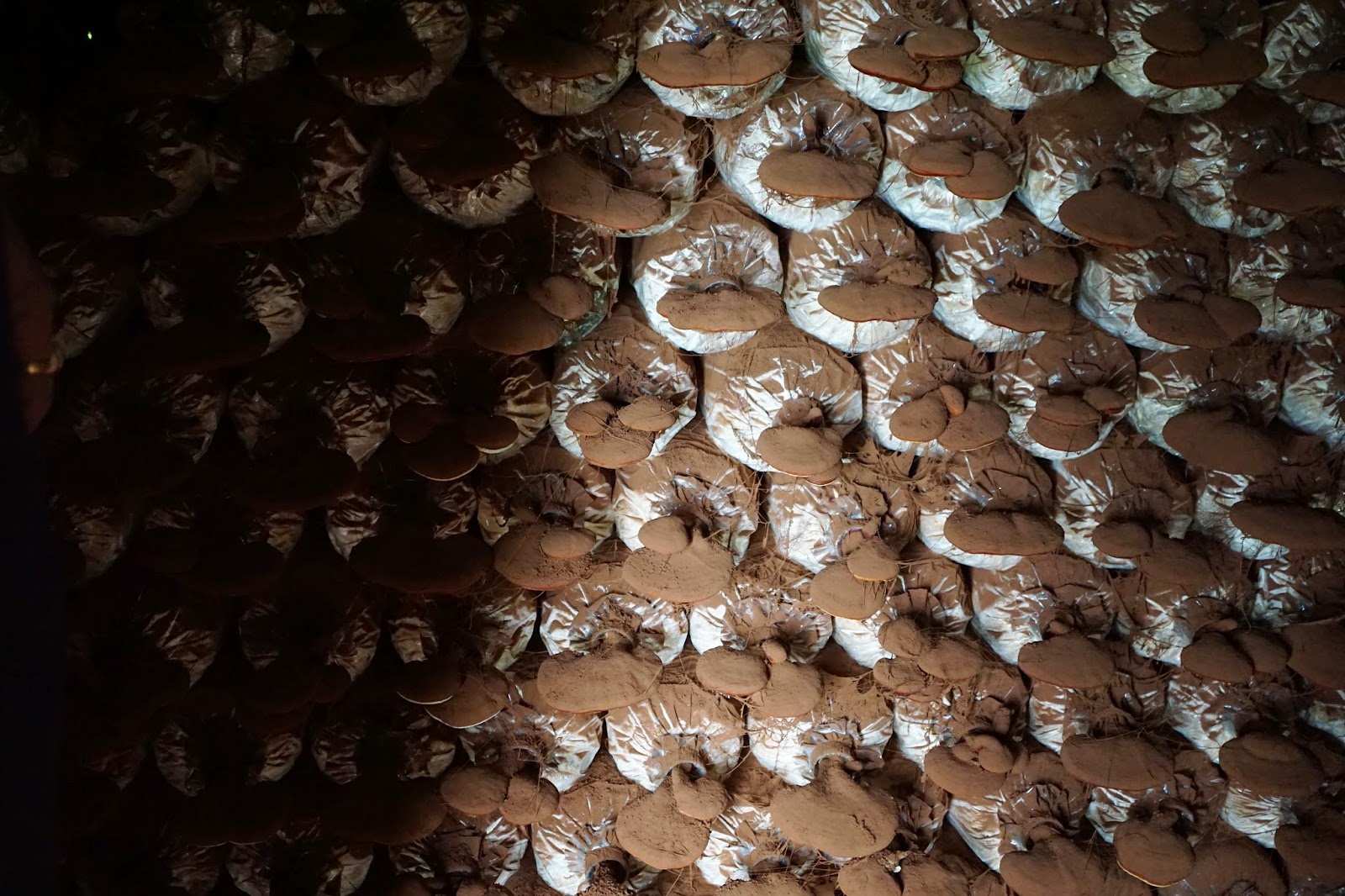
Ganoderma spp. (lingzhi) growing in a dark shed. The spores are used in cosmetics and the fruiting body is made into a tea popular in Asian traditional medicine. 

They take a long time to grow, but produce an abundance of spores. Spores and fruiting body command a relatively high price.

 While this operation seems successful in terms of producing mushrooms and providing accessible education and resources, there are some hurdles to the implementation of low-tech agricultural waste to mushroom programs. First, the strains themselves have to be sourced and maintained. In large-scale production operations like Phillips in PA (see earlier post), the pure culture strain is carefully selected for efficiency and quality, and the initial plates of culture are frozen in liquid nitrogen to maintain the earliest culture and avoid strain degradation. While a huge amount of mushroom culture can be made from a tiny amount of mycelium, this mycelium is not immortal, and if you culture the culture of a culture (etc.) the strain can start to deteriorate over time. Liquid nitrogen storage is simply not available in low-tech or small scale operations. While at this scale strain degradation can be less of a problem simply because less mycelium is produced, "parent" cultures are maintained and bags are inoculated vertically from the "parent" cultures rather than horizontally. This reduces the opportunity for contamination as well.

Another major concern with the reuse of agricultural wastes is substrate contamination. While fungi can often break down carbon-based contaminants, they are also capable of accumulating metals. If a metal-containing pesticide is applied to a crop, and the crop is then used for mushroom production, it is possible that the mushroom will be contaminated as well. It is notable that rubber trees are sometimes treated with arsenic trioxide (pesticide).


Thank you achaan Morakot for your kindness and generosity during my time in Chiang Mai.