Showing posts with label chiang mai. Show all posts
Saturday, August 2, 2014
Accent color of Wat Phalat, on the Pilgrim's Trail to Doi Suthep
Labels:
chiang mai,
doi suthep,
hike,
mushroom,
mycology,
thailand,
thomas j watson fellowship,
wat palad,
wat phalat,
watson fellowship
Saturday, July 26, 2014
Maejo University -- Mushroom Cultivation Training + Sustainability Program
A man in the office redirects us to another nearby large white building, where a similar process repeats. I lose the specifics here, as all conversations have been in Thai.
Eventually we find a young man who is knowledgeable about the mushroom cultivation/education program, though I didn’t catch his actual position. At this point, all program specifics and questions are being translated and this kind of mediated conversation invites imprecise language and some inaccuracy, so some details may reflect that.
The program is rather clever, with a three-fold impact. The first impact is the reuse of agricultural waste products, the second is the production of a nutritious and popular food resource, and the third is the creation of an accessible education resource so farmers can fully apply mushroom cultivation practices on their own. The University produces mushrooms and refines the process based on available materials, holds workshops that allow local rural farmers to grow their own mushrooms and purchase pure cultures from the University lab, and sells pre-made inoculated bags to local villagers who don't have the resources to have a full growing operation. These bags sell for 7 baht each, and can produce (in best conditions) 5 flushes of mushrooms, each worth 12 baht, giving the producer ~50 baht of profit ($1.60) per bag.
The young man leads us through their cultivation system, naturally starting with substrate and ending with growing sheds. Notably, this operation is geared towards primary decomposers and doesn't require the substrate composting like farms growing Agaricus species. This makes for a simpler process.
| Substrate and steam pasteurizing equipment. Substrate was mainly rubber tree sawdust. |
| Ash chute in the sterilizer -- a wood/coal fire heats water into steam which is funneled into industrial drums containing bags of substrate |
| Bags of sterilized substrate, ready to be inoculated |
| This strain exudes a dark liquid. Each strain/species' colony looks a bit different. I'm not sure which species this is, as bottles were grouped and labelled in Thai. |
| Closeup of myceliated millet. |
| Inoculated millet seeds visible at the top of a recently sterilized bag of substrate. |
| "Front" of mycelium as it grows throughout the substrate, top to bottom. It may take a week or more to get to this point. Probably a Pleurotus species. |
| A particularly beautiful growth pattern. Species uncertain. |
| Fully colonized bags, ready to be placed in a temp/humidity (semi)controlled room for fruiting. |
| A stack of bags in the fruiting room. |
| Underside detail |
| The product. |
| Consequences of some form of bacterial contamination. |
| Another product. |
| Product in situ. |
| Ganoderma spp. (lingzhi) growing in a dark shed. The spores are used in cosmetics and the fruiting body is made into a tea popular in Asian traditional medicine. |
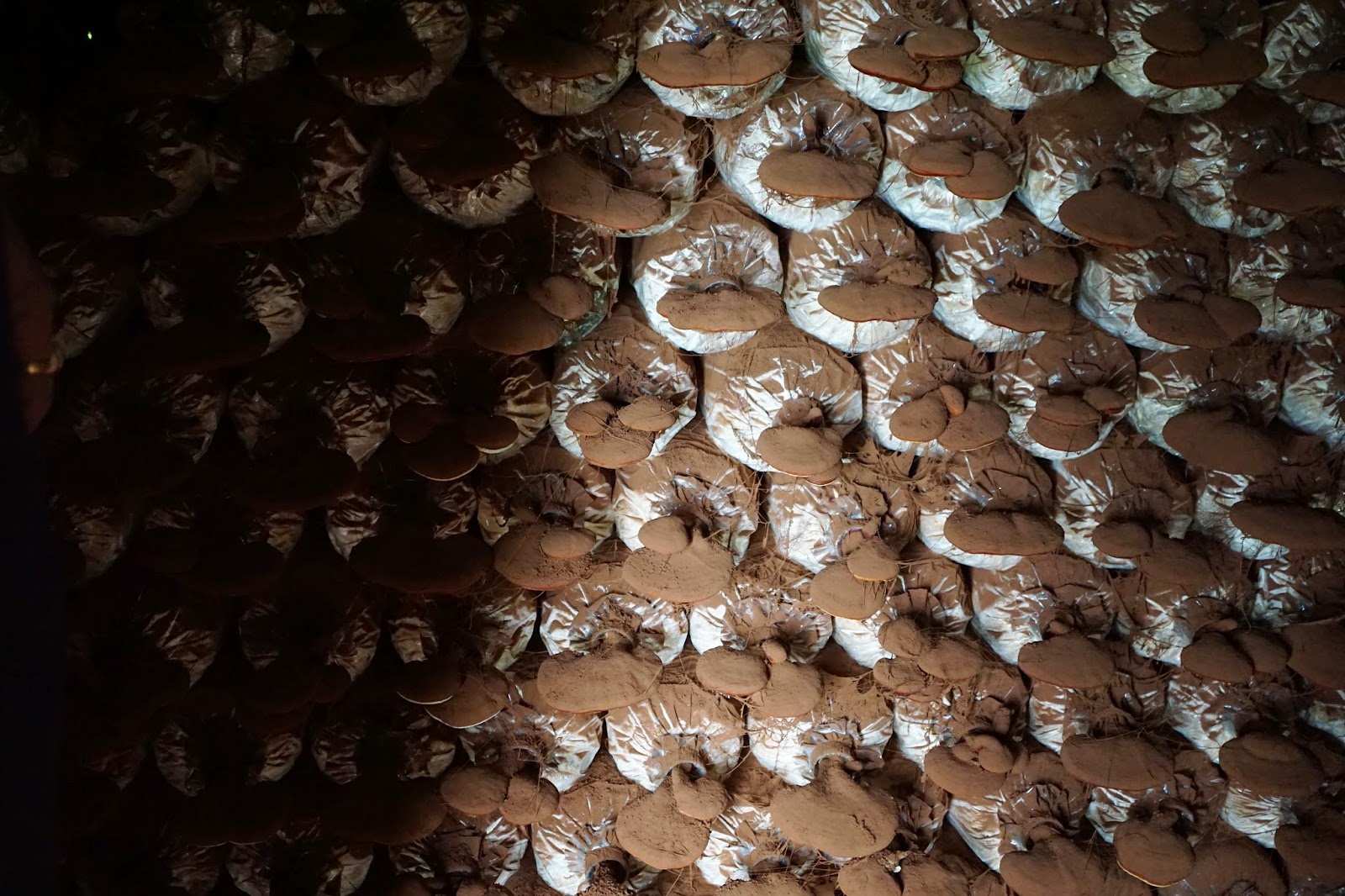
| They take a long time to grow, but produce an abundance of spores. Spores and fruiting body command a relatively high price. |
Another major concern with the reuse of agricultural wastes is substrate contamination. While fungi can often break down carbon-based contaminants, they are also capable of accumulating metals. If a metal-containing pesticide is applied to a crop, and the crop is then used for mushroom production, it is possible that the mushroom will be contaminated as well. It is notable that rubber trees are sometimes treated with arsenic trioxide (pesticide).
Thank you achaan Morakot for your kindness and generosity during my time in Chiang Mai.
Friday, July 18, 2014
Mushrooms in my second day of Thai food
I'm not in the habit of taking pictures of meals and it's not something I'm skilled at, but it seemed appropriate given the circumstances.
Straw mushrooms (Volvariella volvacea) in a soup that cleared my sinuses and led to the bottom of my 2nd (of 5) liter of water
Enokitake (Flammulina velutipes) wrapped in bacon, and grilled king oyster (Pleurotus eryngii). This stall at an open-air market also had steamed oyster mushrooms (Pleurotus spp.-- these oysters had morphological differences including a narrower base compared to the ones I'm most familiar with, which may be a result from different growing conditions, or they may be a different species than P. ostreatus, hence the "spp."). I was considering trying to ask them where they buy them, but they were doing pretty swift business. Maybe next time. All varieties they were selling are commonly commercially cultivated anyway, so there probably wasn't much info to glean.
Interesting note about enokitake: they are grown in particular controlled conditions (likely no light, maybe controlled CO2) that make their appearance vastly different from wild individuals of the same species. If you google the species name, you'll find very little resemblance between cultivated and wild specimens.
Wednesday, July 16, 2014
Hed paw - a source of admiration, pollution, and naming confusion
On the plane from Bangkok to Chiang Mai yesterday, I sat next to a friendly American expat, Craig, who mentioned that the hill tribe people do semi-controlled burns that have something to do with mushroom collecting. He googled it on his phone before takeoff, and confirmed that the burns are set to facilitate the collection of "hed paw/hed tawp," some sort of semi-buried mushroom that isn't cultivated and can be sold for high prices (source). While these mushrooms are highly sought after, the unpopular burns conducted to find them are blamed for some of the air pollution in the area.
Based on this initial description, I expect these fungi are mycorrhizal (hence practically impossible or economically unfeasible to cultivate). The brief and vague description reminded me of morels, which are mycorrhizal, not commercially cultivated, expensive, and are found in great numbers after fires. I asked Keith, the friendly British expat guesthouse proprietor, if he was familiar with any of the mushrooms sold locally, and he spoke highly of some sort of brown, round, lumpy mushroom, sometimes called the Chiang Mai truffle. He said they are very seasonal (suggesting that they aren't cultivated), and I expect that these brown lumps are the "hed paw" mushroom.
After a bit more googling, it looks like the mushroom is a "false earthstar" (Astraeus spp.), a widely found genus of mycorrhizal fungi. One source that discussed the mushroom in the context of the slash-and-burn approach of the hill tribes called it Astraeus hygrometricus, though this name was given to most similar Astraeus species globally and represented a species complex until the early 2000s. According to Wikipedia, molecular and morphological evidence indicates that Thai Astraeus species previous lumped under the name A. hygrometricus include Astraeus asiaticus Phosri, M.P.Martín & Watling (2007) and Astraeus odoratus Phosri, Watling, M.P.Martín & Whalley (2004) syn. thailandicus Petcharat (2003). There is some uncertainty about whether the burns are set to clear the underbrush and make the mushrooms easily visible or if the fire itself triggers a flush of fruiting, as with morel species. For more info, one of the Wiki sources (a 2004 Mycotaxon pub, "The genus Astraeus in Thailand") is free access. The excellent Cornell mycology blog also did a post about Astraeus species in North America v. ones in Thailand very recently that does a better job of describing the problem with naming within the Astraeus genus.
I trotted downstairs and asked Keith if the image on the Cornell blog matched the mushroom he was fond of, and he confirmed that it did. Raitree, a Thai woman and the other proprietor of the guesthouse, quickly named it in Thai -- "hed paw" indeed. She then called one of her friends who said the season ended two months ago in May, but I'm still going to keep my eyes peeled for brown lumps (and other mushrooms) at the Sunday market.
UPDATE- 9/8, found some Astraeus sp. (tentatively ID-ed, pictured above) in Ban Tak. A local called it "het thawp," suggesting it is the species that they consume when immature.
| Mature Astraeus sp. |
Based on this initial description, I expect these fungi are mycorrhizal (hence practically impossible or economically unfeasible to cultivate). The brief and vague description reminded me of morels, which are mycorrhizal, not commercially cultivated, expensive, and are found in great numbers after fires. I asked Keith, the friendly British expat guesthouse proprietor, if he was familiar with any of the mushrooms sold locally, and he spoke highly of some sort of brown, round, lumpy mushroom, sometimes called the Chiang Mai truffle. He said they are very seasonal (suggesting that they aren't cultivated), and I expect that these brown lumps are the "hed paw" mushroom.
| Immature Astraeus sp. - when they are eaten |
After a bit more googling, it looks like the mushroom is a "false earthstar" (Astraeus spp.), a widely found genus of mycorrhizal fungi. One source that discussed the mushroom in the context of the slash-and-burn approach of the hill tribes called it Astraeus hygrometricus, though this name was given to most similar Astraeus species globally and represented a species complex until the early 2000s. According to Wikipedia, molecular and morphological evidence indicates that Thai Astraeus species previous lumped under the name A. hygrometricus include Astraeus asiaticus Phosri, M.P.Martín & Watling (2007) and Astraeus odoratus Phosri, Watling, M.P.Martín & Whalley (2004) syn. thailandicus Petcharat (2003). There is some uncertainty about whether the burns are set to clear the underbrush and make the mushrooms easily visible or if the fire itself triggers a flush of fruiting, as with morel species. For more info, one of the Wiki sources (a 2004 Mycotaxon pub, "The genus Astraeus in Thailand") is free access. The excellent Cornell mycology blog also did a post about Astraeus species in North America v. ones in Thailand very recently that does a better job of describing the problem with naming within the Astraeus genus.
| Interior endoperidium brown with spores forming; exoperidium splits into a star shape when mature, and lifts endoperidium above leaf litter to eject spores. |
I trotted downstairs and asked Keith if the image on the Cornell blog matched the mushroom he was fond of, and he confirmed that it did. Raitree, a Thai woman and the other proprietor of the guesthouse, quickly named it in Thai -- "hed paw" indeed. She then called one of her friends who said the season ended two months ago in May, but I'm still going to keep my eyes peeled for brown lumps (and other mushrooms) at the Sunday market.
UPDATE- 9/8, found some Astraeus sp. (tentatively ID-ed, pictured above) in Ban Tak. A local called it "het thawp," suggesting it is the species that they consume when immature.
Labels:
astraeus asiaticus,
astraeus hygrometricus,
astraeus odoratus,
astraeus thailandicus,
chiang mai,
chiang mai truffle,
hed paw,
hed tawp,
hill tribe,
mushroom,
mycology,
taxonomy,
thailand
Subscribe to:
Posts (Atom)

